
How to Use a Mining Calculator Without Fooling Yourself
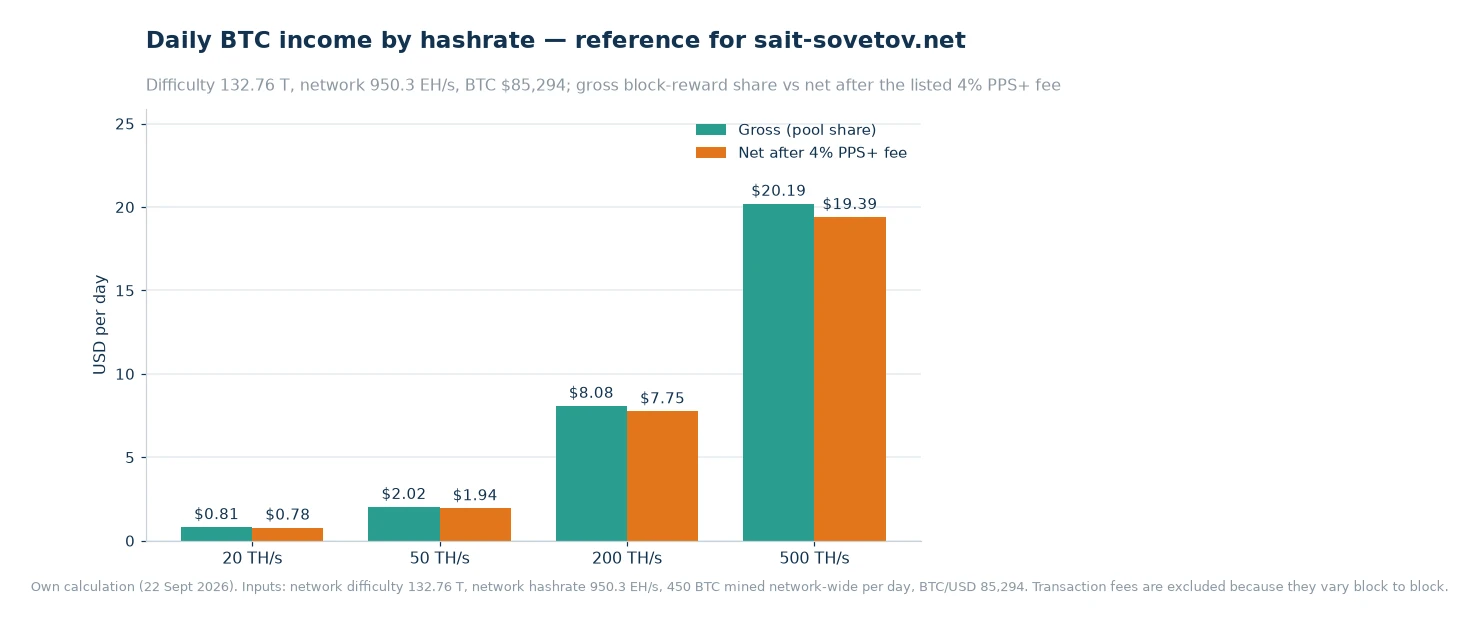
A calculator that answers "200 TH/s earns $8.08 a day" is not wrong, it is unfinished. At difficulty 132.76 T that hashrate produces 0.00009471 BTC a day, worth $8.08 at $85,294 per BTC, and the listed 4% block-reward fee leaves $7.75. Then the machines draw power: 200 TH/s at 20 J/TH is 4 kW, about 96 kWh a day, which costs $5.76 at $0.06 per kWh. The real margin on that day is $1.99.

Key takeaways
- Gross output at 200 TH/s is 0.00009471 BTC a day, or $8.08 at $85,294; the listed 4% block-reward fee takes it to about $7.75.
- Power is the input most often left blank: 200 TH/s at 20 J/TH uses 96 kWh a day, which is $5.76 at $0.06 per kWh.
- At 20 J/TH the breakeven electricity price is $0.0841 per kWh gross and $0.0808 per kWh after the listed 4% fee.
- Difficulty is not a constant: the next adjustment is estimated at 1.90%, which trims income per terahash by about 1.86%.
The inputs that decide the answer
Four inputs do the work: hashrate, difficulty, the price of the coin, and the cost of running the hardware. The Profit Calculator takes exactly that set — coin price, difficulty, the listed fee rate, and effective hashrate — and returns an estimate for the day, including any merged-mining output the coin produces. What separates a useful run from a misleading one is not the tool but the numbers typed into it.
Effective hashrate is the first trap. Nameplate figures describe a machine in a cool room with fresh firmware; a fleet two years into service, or one running in a warm climate, delivers less. Enter the hashrate your dashboard reports, not the one on the box. Difficulty is the second trap, because a calculator run against a difficulty figure from three weeks ago quietly overstates income. At 132.76 T, one terahash per second earns 0.0000004735 BTC a day; if difficulty rises by the estimated 1.90%, that per-terahash figure falls by about 1.86%.
How a calculator run goes wrong
The failure modes are consistent enough to list. Each one is a missing input rather than a wrong formula, and each has a price in dollars that can be calculated in advance.
| Input | Value to enter now | Cost of getting it wrong |
|---|---|---|
| Effective hashrate | 200 TH/s = 0.00009471 BTC a day = $8.08 at $85,294 | Using nameplate hashrate instead of the dashboard figure overstates output by the whole gap |
| Network difficulty | 132.76 T, with the next adjustment estimated at 1.90% | A stale figure overstates per-terahash income; the estimated rise trims it by about 1.86% |
| Listed fee rate | 4% on the PPS-settled block reward, 2% on transaction fees under PPS+ | Treating it as one blended rate on the total misstates both the fee and the net |
| Power draw | 20 J/TH means 96 kWh a day at 200 TH/s | At $0.06 per kWh the omission overstates margin by $5.76 a day |
| Uptime | One hour down at 200 TH/s is about $0.34 of gross output | A 99% uptime assumption hides roughly $2.42 of monthly output at this size |
The power row changes the verdict more often than any other. At 20 J/TH, the breakeven electricity price is $0.0841 per kWh before the fee and $0.0808 per kWh after the listed 4% charge on the block-reward component. An operator paying $0.10 per kWh at that efficiency is working for free, whatever the gross line says.
Worked example
Run the arithmetic line by line at 200 TH/s. Output per terahash per day is 0.0000004735 BTC, so 200 x 0.0000004735 = 0.00009471 BTC. At $85,294 per BTC that is $8.08 a day. The listed 4% fee on the block-reward component is 0.04 x $8.08 = $0.32, leaving $7.75. Power comes next: 200 TH/s x 20 J = 4,000 watts, or 4 kW; 4 kW x 24 hours = 96 kWh; at $0.06 per kWh the power bill is $5.76 a day. Margin: $7.75 - $5.76 = $1.99 a day, or about $59.70 over 30 days.
Stress one more input: price. The same 200 TH/s earning 0.00009471 BTC a day is worth $8.08 at $85,294, but at $70,000 the identical output is $6.63 gross and $6.36 after the listed 4% fee, which after $5.76 of power leaves about $0.60 a day. A machine can look comfortable at one price and sit on the edge of breakeven at another without a single bolt being turned, which is why the price you type in should be the price you would actually sell at.
Change one input. At 15 J/TH the same 200 TH/s draws 3 kW, or 72 kWh a day, and the power bill falls to $4.32. The margin rises to $3.43 a day, roughly $102.90 a month, without a single terahash being added. That is the point of entering power properly: on a calculator, efficiency is often worth more than scale.
Efficiency is also the input that decides how much room a tariff move leaves you. The breakeven electricity price at 20 J/TH is $0.0841 per kWh before the fee and $0.0808 per kWh after it; step up to 15 J/TH hardware and the second figure becomes $0.1077 per kWh. Higher efficiency adds no hashrate at all, it simply buys headroom between the power bill and the income line, which is why the two inputs belong in the same run rather than in separate spreadsheets.
Uptime deserves the same treatment even though the tool never asks for it. A fleet running 98% of a month loses about 0.6 days of output, which at 200 TH/s is 0.00005683 BTC, or $4.85 of gross income — roughly half the fee the same fleet pays across 30 days. Entering nameplate hashrate and assuming continuous operation is the quickest way to make a calculator disagree with a statement.
Running the numbers on the fleet you actually have
Open the ViaBTC Mining Calculator with the dashboard figure for effective hashrate, the current difficulty, the price you would actually sell at, and the listed fee rate for the payment method you use. Run it once with power included and once without, and keep both numbers — the gap between them is your margin, and it is the figure that decides whether a machine stays plugged in.
Then cross-check the machines themselves. The Miner Profitability Ranking shows what each ASIC model earns at today's price and difficulty, which is the quickest way to see whether an older rig is still covering its own electricity, and the Statistics page confirms the pool and network levels the estimate was built on. Where the calculator and your own statement disagree, the statement is right: reconcile the two and find which input you mis-entered.
Frequently asked questions
Should I enter gross income or net income into a calculator?
Enter gross and let the tool apply the listed fee. At 200 TH/s the gross line is $8.08 a day and the listed 4% block-reward fee takes about $0.32 off it, leaving $7.75.
How often should a calculator run be repeated?
After each difficulty adjustment and whenever the coin price moves materially. The next adjustment is estimated at 1.90%, which lowers income per terahash by about 1.86%.
Why does the calculator show more than my statement?
Usually because of power, uptime or stale difficulty. Power alone accounts for $5.76 a day at 200 TH/s running 20 J/TH hardware at $0.06 per kWh.
Treat the calculator as a checklist
Fill in hashrate from the dashboard, difficulty from the current epoch, the price you would sell at, and the listed rate for your payment method, then subtract power before you look at the result. Save each run with its date so you can see how the estimate moved when difficulty changed. Used that way the tool is not a forecast; it is a way of proving that a machine still makes money after everything has been paid for.
Data and sources: the Profit Calculator from ViaBTC[1] and listed fee schedule[2]. The run uses values read 22 Sept 2026: difficulty 132.76 T, network hashrate 950.3 EH/s and BTC at $85,294. Electricity prices quoted are illustrative examples rather than tariffs. Figures follow from those inputs and shift with difficulty, price and local power rates; no earnings are promised.